Why Most Companies Will Waste Money on ChatGPT Ads
As with every new channel, early adoption often leads to wasted spend due to misunderstanding. This blog outlines the most common mistakes companies will make when entering ChatGPT advertising and why those mistakes lead to poor performance.
Market Reality & Strategic Positioning
7 min read
New Channels Don’t Fail — Companies Misuse Them
Every time a new advertising channel emerges, there is a predictable pattern that follows. Early interest builds, companies begin experimenting, budgets are allocated, and then a large portion of that spend produces disappointing results. This is not because the channel itself is ineffective, but because most companies approach it using frameworks that were built for entirely different environments. Instead of understanding how the new system works, they attempt to force it into existing models. The result is not just underperformance, but systematic waste.
ChatGPT Ads will follow this exact pattern. Despite the clear shift in how users interact inside conversational AI platforms, most companies will enter this channel with the wrong assumptions. They will treat it as an extension of search or social, apply familiar tactics, and expect similar outcomes. When those outcomes do not materialize, they will either increase spend in an attempt to compensate or abandon the channel prematurely, concluding that it “doesn’t work.” In reality, the issue will not be the channel, but the way it was approached.
Mistake 1: Treating ChatGPT Like Search Advertising
One of the most common mistakes companies will make is treating ChatGPT Ads as if they function like search ads. In search advertising, the objective is to match keywords, appear in relevant queries, and drive clicks to a landing page where the user can convert. The system is built around directing traffic away from the platform and into a controlled environment where the business can continue the conversion process.
Inside ChatGPT, this model breaks down. The user is not looking for links to explore further. They are looking for answers that help them decide. The interaction is self-contained, and the decision may happen entirely inside the conversation. If a company approaches this environment with a mindset focused on driving clicks, it will miss the actual point of influence, which is the answer itself.
This leads to misaligned strategies where messaging is designed to attract attention or encourage clicks rather than contribute to the decision process. As a result, the ad may be visible but ineffective, because it does not align with the user’s intent. The spend is technically deployed, but it does not translate into meaningful outcomes.
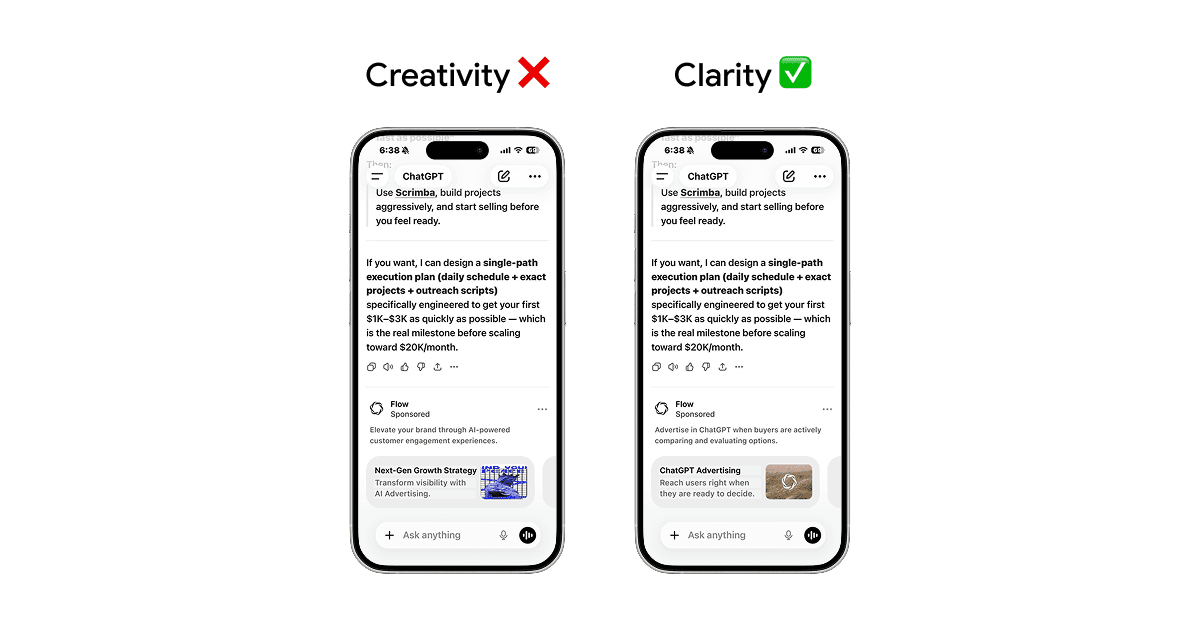
Mistake 2: Over-Prioritizing Creativity Instead of Context
Another major source of wasted spend comes from over-reliance on creative elements. In traditional advertising, creativity is often the primary lever for improving performance. Companies invest heavily in visuals, storytelling, and emotional hooks because these elements help capture attention in crowded environments. However, inside ChatGPT, the environment is not crowded in the same way, and attention is not the primary constraint.
When companies bring creative-heavy strategies into conversational advertising without adapting them, they often produce messages that are visually or stylistically strong but contextually weak. The messaging may look polished, but it does not directly address the user’s query or support their decision-making process. In a conversation where the user is seeking clarity, this type of messaging becomes irrelevant.
This misalignment leads to poor performance because the ad fails to integrate into the flow of the conversation. The user does not engage with it because it does not help them move closer to a decision. As a result, spend is allocated to assets that do not influence outcomes, creating the impression that the channel itself is ineffective.
Mistake 3: Ignoring the Decision Flow Dynamics
Perhaps the most significant mistake companies will make is failing to understand how decisions are actually formed inside ChatGPT interactions. Unlike traditional funnels where users move through defined stages over time, conversational AI compresses the evaluation process into a single flow. The user asks a question, receives structured information, and moves toward a conclusion within the same interaction.
If a company does not understand this flow, it cannot position itself effectively inside it. Messaging that might work at an early awareness stage may be completely ineffective at a decision stage. For example, broad value propositions or brand-level messaging may not provide the specificity needed when a user is comparing options. Without aligning messaging to the exact point in the decision process, the ad fails to influence the outcome.
Ignoring these dynamics leads to a situation where companies are present in the conversation but not positioned correctly within it. They are visible, but not relevant. And in a decision-driven environment, relevance is what determines whether a brand is chosen.
Mistake 4: Measuring the Wrong Things
Even when companies manage to deploy ads inside ChatGPT, they often evaluate performance using the wrong metrics. They look for clicks, impressions, and engagement rates, expecting these indicators to reflect success in the same way they do in traditional channels. However, as discussed earlier, these metrics do not fully capture what matters داخل conversational environments.
When decisions are made inside the conversation, the absence of clicks does not necessarily indicate failure. A user may receive the information they need and make a decision without leaving the platform. If companies rely solely on click-based metrics, they may underestimate the impact of their ads or misinterpret the results entirely.
This leads to poor optimization decisions. Campaigns that are actually influencing decisions may be scaled down because they do not generate enough clicks, while campaigns that generate superficial engagement may be scaled up despite having little impact on outcomes. Over time, this misalignment compounds, resulting in inefficient spend and missed opportunities.
Mistake 5: Underestimating the Learning Curve
Another reason why companies will waste money on ChatGPT Ads is that they underestimate the learning curve associated with this new environment. Because the concept of advertising is familiar, there is a tendency to assume that existing knowledge can be transferred inside. However, while the objective of influencing user behavior remains the same, the mechanisms through which that influence is applied are different.
Understanding how to operate inside conversational environments requires new capabilities. It involves analyzing how users phrase their queries, how AI systems structure responses, and how different types of messaging affect decision outcomes. This is not something that can be mastered instantly. It requires experimentation, iteration, and a willingness to move away from established practices.
Companies that assume they can achieve immediate results without going through this learning process are likely to misallocate resources. They may invest heavily upfront, expect quick returns, and become discouraged when those returns do not materialize. The issue is not the lack of potential, but the lack of understanding.
Why These Mistakes Lead to Wasted Spend
All of these mistakes share a common root: misalignment between strategy and environment. When a company applies the wrong framework, it directs resources toward actions that do not produce the intended outcomes. The spend is real, but the impact is limited. This creates a perception of inefficiency, even though the underlying opportunity remains intact.
Wasted spend is not just a financial issue. It also affects decision-making. When early experiments produce poor results, companies may become hesitant to invest further. They may conclude that the channel is not worth pursuing, allowing competitors who approach it correctly to gain an advantage. In this way, initial missteps can have long-term consequences.
Proper Execution Is Not Optional — It’s the Difference
The key takeaway is that success inside ChatGPT advertising is not automatic. It is not enough to simply participate in the channel. The way in which a company participates determines whether it captures value or wastes resources. Proper execution requires understanding how decisions are made inside the platform, aligning messaging with user intent, and measuring performance based on outcomes rather than surface-level metrics.
This makes the channel non-trivial. It is not a plug-and-play extension of existing strategies. It requires a deliberate approach that is tailored to the unique characteristics of conversational environments. Companies that recognize this and invest in building the necessary capabilities will be better positioned to succeed.
The Cost of Getting It Wrong Will Increase Over Time
In the early stages of a new channel, the cost of mistakes is relatively low because competition is limited and expectations are still forming. However, as more companies enter the space and best practices begin to emerge, the cost of misalignment increases. Inefficient spend becomes more noticeable, and the gap between those who understand the channel and those who do not becomes more pronounced.
This means that the window for learning at a lower cost is limited. Companies that delay adaptation or approach the channel incorrectly may find themselves at a disadvantage as the ecosystem matures. The cost of catching up later is often higher than the cost of learning early.
Wasted Spend Is a Choice, Not an Outcome\
Ultimately, whether a company wastes money on ChatGPT Ads is not determined by the channel itself, but by how the company approaches it. The opportunity is real, and the potential for value creation is significant. However, realizing that potential requires a shift in thinking, a willingness to move beyond familiar frameworks, and a focus on aligning strategy with how the environment actually works.
Companies that treat this as just another channel will likely repeat the same mistakes that have occurred in every previous shift. Companies that treat it as a new system with its own dynamics will be able to capture value more effectively. The difference between these two approaches is not subtle. It is the difference between wasted spend and meaningful outcomes.
Similar Blogs

Prepare Your Business for Advertising Inside AI Platforms
If your organization is exploring how AI platforms may influence customer acquisition, the AI Ads Readiness Program helps you understand where your brand stands today — and how to prepare for where advertising inside AI systems is going.