Why Creativity Loses and Clarity Wins in ChatGPT Advertising
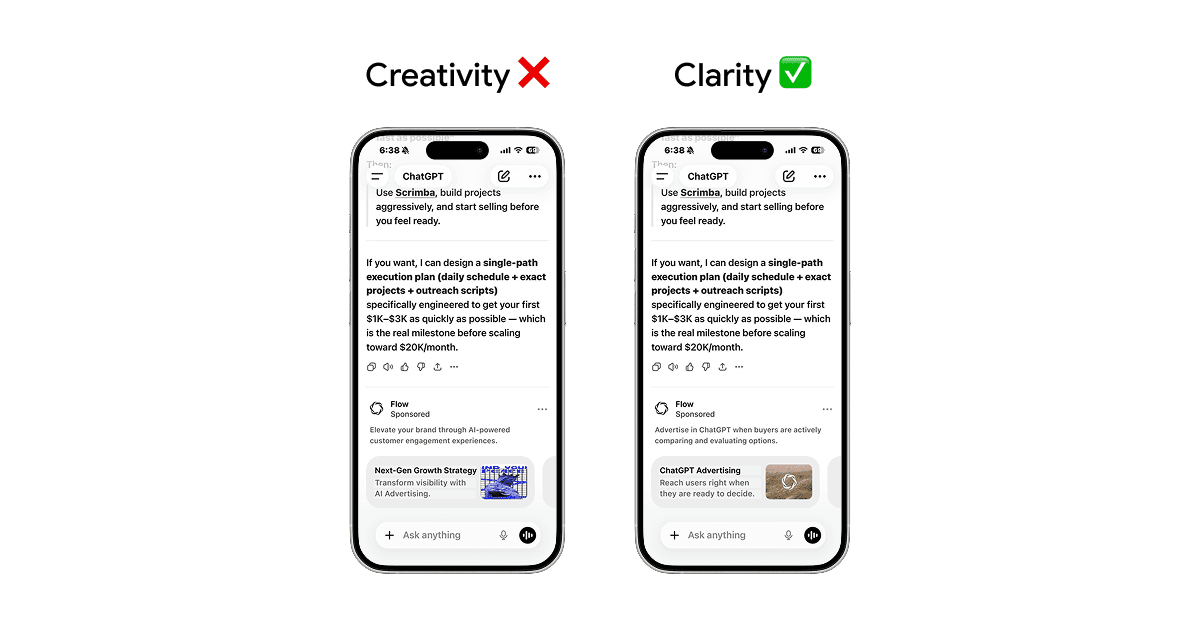
In traditional advertising, creativity and visual appeal often drive performance. But inside ChatGPT, users are not looking to be entertained—they are looking to decide. This blog explains why clarity, relevance, and alignment with user intent outperform creative gimmicks in conversational environments.
Ad Performance & Economics
7 min read
Creativity Was Built for Attention, Not Decisions
For most of modern advertising history, creativity has been treated as the primary driver of performance. The logic behind this is straightforward: in environments where users are exposed to a high volume of content, the ability to stand out becomes valuable. Creative elements such as visuals, storytelling, emotional hooks, and unique messaging are designed to capture attention, differentiate a brand, and make an impression that lasts long enough to influence behavior. This is why some of the most successful advertising campaigns have been those that are memorable, entertaining, or emotionally engaging.
This approach works because it aligns with how traditional advertising environments function. On platforms like television, social media, and even search to some extent, users are not always actively looking to make a decision. They are browsing, scrolling, or consuming content passively. In this context, creativity acts as a disruption mechanism. It interrupts the user’s flow, captures their attention, and creates an opportunity for the brand to insert itself into their awareness. The more effective the creative, the higher the likelihood that the user will engage, click, or remember the brand later.
However, this entire framework depends on one key condition: the user must be in a state where attention is scarce and needs to be captured. Once that condition changes, the role of creativity changes with it.
ChatGPT Is Not an Attention Economy Environment
Conversational AI platforms like ChatGPT operate under a completely different set of conditions. The user is not passively consuming content or scrolling through a feed. They are actively engaging with the system, asking specific questions, and seeking direct answers. Their attention is not fragmented across multiple stimuli. It is focused on resolving a particular problem or making a specific decision.
This means that the competition for attention, which is central to traditional advertising, is largely absent in this environment. The user has already committed their attention to the interaction. They are not looking for something that stands out visually or emotionally. They are looking for something that helps them move forward with clarity. In other words, the bottleneck is no longer attention. It is understanding.
Because of this, the role of advertising inside ChatGPT shifts away from capturing attention and toward supporting the user’s reasoning process. The question is not whether the ad is interesting or memorable. The question is whether it is useful in the context of the user’s query.
Why Creativity Becomes a Weak Lever
When users are in a decision-making state, their priorities change. They are no longer evaluating content based on how engaging or entertaining it is. They are evaluating it based on how relevant, clear, and helpful it is in answering their question. Creative elements that are designed to attract attention can become distractions if they do not directly contribute to the user’s objective.
This is where many traditional advertising approaches begin to fail inside conversational environments. Messaging that relies on emotional appeal, abstract storytelling, or exaggerated claims may perform well in attention-driven contexts, but it often lacks the precision required to influence decisions. When a user is asking, “Which course should I choose?” they are not looking for a compelling narrative. They are looking for specific information that helps them compare options and arrive at a conclusion.
In this context, creativity does not disappear, but its role is significantly reduced. It is no longer the primary lever for performance. Instead, it becomes secondary to clarity. If a message is creative but unclear, it will not be effective. If it is clear but not particularly creative, it can still perform well because it aligns with the user’s intent.
Clarity Aligns With How Decisions Are Made
Clarity becomes the dominant factor in conversational advertising because it directly supports the decision-making process. When a user is evaluating options, they are trying to reduce uncertainty. They want to understand the differences between choices, the trade-offs involved, and the likely outcomes of each option. A clear message provides this information in a way that is easy to process and act on.
Inside ChatGPT, this clarity must be tightly aligned with the user’s query. The message should address the exact question being asked, using language that is straightforward and specific. It should avoid unnecessary complexity and focus on delivering the most relevant information in the most efficient way possible. This does not mean the message has to be simplistic, but it does mean it has to be precise.
Clarity also increases trust. When information is presented in a direct and understandable manner, it is easier for the user to evaluate its credibility. In a decision context, trust plays a critical role because the user is relying on the information to make a choice that may have real consequences. A clear message reduces cognitive effort and increases confidence, both of which contribute to the likelihood of selection.
From Persuasion to Decision Support
Another important shift is the move from persuasion to decision support. Traditional advertising often aims to persuade users by influencing their emotions, shaping their perceptions, or creating a sense of urgency. While these techniques can still have some impact, they are less effective when the user is actively seeking objective information.
In conversational environments, the role of advertising is closer to that of a guide than a persuader. The message should help the user navigate their options, understand key factors, and make an informed decision. This requires a different mindset. Instead of asking, “How do we convince the user to choose us?” the more relevant question becomes, “How do we help the user make the best decision, and ensure we are positioned as the right choice within that process?”
This does not eliminate competitive positioning, but it changes how it is expressed. Instead of relying on broad claims or emotional appeals, the focus shifts to demonstrating relevance, explaining advantages clearly, and aligning with the user’s specific needs.
Why Most Creative Strategies Will Fail Without Adaptation
Most companies have built their advertising capabilities around creative optimization. They invest in design, copywriting, and storytelling because these elements drive performance in traditional channels. However, when these same strategies are applied inside ChatGPT without adaptation, they often underperform because they are misaligned with the environment.
The failure is not due to a lack of creativity, but due to a mismatch between the strategy and the context. Creative approaches that prioritize differentiation through style or tone may not translate into relevance inside a conversation. If the message does not directly address the user’s query, it will be ignored regardless of how well it is crafted.
This creates a situation where companies may continue to iterate on creative elements, believing that performance issues are due to execution rather than strategy. In reality, the issue is that they are optimizing the wrong variable. They are trying to improve how the message looks or feels, when they should be focusing on how it aligns with the decision process.
Clarity Is Not Simplicity — It Is Precision
It is important to clarify that clarity does not mean oversimplification. A clear message is not one that removes all complexity, but one that presents complexity in a structured and understandable way. In many cases, decisions inside conversational environments involve multiple factors, such as cost, quality, time commitment, and outcomes. A clear message acknowledges these factors and addresses them directly.
Precision is what differentiates clarity from generic simplicity. A precise message speaks directly to the user’s situation, uses specific language, and avoids ambiguity. It provides enough detail to support a decision without overwhelming the user with unnecessary information. This balance is critical because the user is looking for guidance, not exhaustive analysis.
The Competitive Advantage Will Shift to Clarity
As more companies begin to advertise inside conversational AI platforms, the ability to deliver clear, relevant, and context-aligned messaging will become a key differentiator. While many teams will continue to rely on traditional creative strategies, those that prioritize clarity will be better positioned to influence decisions.
This does not mean that creativity becomes irrelevant. It means that creativity must be redefined. Instead of being used to capture attention, it should be used to enhance clarity, improve understanding, and make information easier to process. Creativity that supports clarity can still be valuable, but creativity that replaces clarity will consistently underperform.
Over time, this shift will become more apparent as performance data reflects the difference between messages that align with user intent and those that do not. The companies that recognize this early will be able to adapt their strategies and gain an advantage inside a channel where most others are still learning.
Advertising Is Becoming More Functional Than Expressive
The broader implication of this shift is that advertising inside conversational environments becomes more functional and less expressive. Its primary role is to assist in decision-making rather than to create emotional resonance or brand recall. This does not eliminate branding, but it changes how branding is achieved. Instead of being built through repeated exposure and creative storytelling, it is built through consistent alignment with user needs and reliable support during decision moments.
This makes advertising more outcome-driven and less dependent on subjective elements. Performance becomes tied to how effectively a message helps users reach a decision, rather than how memorable or engaging it is. As a result, the skills required to succeed in this environment are different. They involve understanding user intent, structuring information clearly, and aligning messaging with the logic of the conversation.
The companies that adapt to this model will find that they can influence decisions more directly and more efficiently. Those that continue to rely on creativity as their primary lever will struggle to achieve the same level of impact because they are optimizing for a condition—attention—that is no longer the primary constraint.
Similar Blogs


Prepare Your Business for Advertising Inside AI Platforms
If your organization is exploring how AI platforms may influence customer acquisition, the AI Ads Readiness Program helps you understand where your brand stands today — and how to prepare for where advertising inside AI systems is going.