When ChatGPT Ads Work vs When They Don’t
A clear breakdown of when ChatGPT Ads actually perform, when they don’t, and how to determine if your business is a strong fit.
Ad Performance & Economics
9 min read
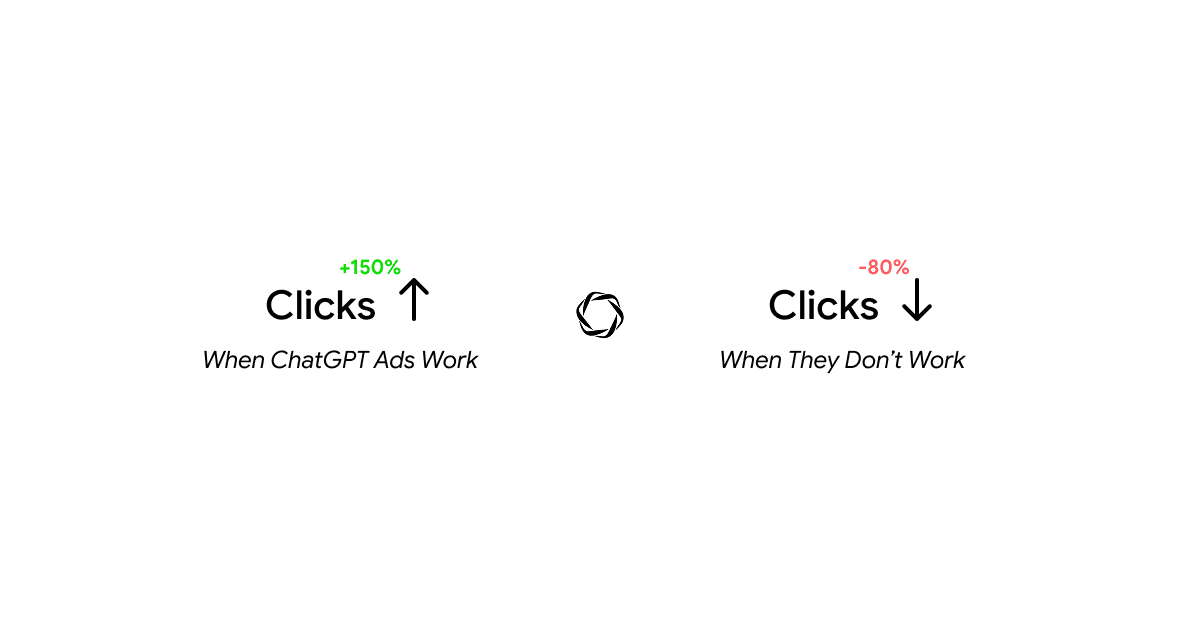
As ChatGPT Ads start gaining attention, most businesses are asking a simple question: “Do they work?”
The problem is, that question assumes the answer is universal. Early results already show that it isn’t. Some companies are seeing strong performance, while others are struggling to get meaningful results.
The more useful question is not whether ChatGPT Ads work, but whether they work for your specific type of customer and decision process. Because in this environment, performance depends less on the platform and more on how decisions are made.
This Is Not a Traffic Channel
One of the biggest mistakes is treating ChatGPT like another acquisition channel similar to Google or Meta.
It doesn’t function as a search engine where users scan links, nor as a feed where they scroll through content. Instead, it acts as a structured environment where users ask questions, evaluate options, and narrow down choices in real time.
In other words, ChatGPT is not designed to generate traffic. It is designed to help users decide.
That distinction changes how and when advertising becomes effective.
The Core Principle Behind Performance
At the center of ChatGPT Ads performance is one variable: how complex the user’s decision is.
Some decisions are simple. The user already knows what they want and just needs to complete the purchase. Others are more involved — they require comparison, evaluation, and clarity before a choice can be made.
This leads to a defining principle:
The more a user needs help deciding, the better ChatGPT Ads perform.
This is not about the product itself, but about the decision process behind it.
Where ChatGPT Ads Perform Well
ChatGPT Ads tend to perform best in environments where the user is actively trying to figure out the right choice.
These situations typically include:
decisions with multiple valid options
scenarios where trade-offs need to be considered
purchases that carry some level of importance or risk
This is why certain categories align naturally with the platform:
education and e-learning — users compare courses, formats, and outcomes
SaaS and software tools — buyers evaluate features, pricing, and use cases
B2B services — decisions involve trust, fit, and long-term value
high-consideration products — users want to make the “right” decision, not just a quick one
In each of these cases, the user is not just searching — they are deciding. And that’s where ChatGPT becomes influential.
What the User Is Actually Doing in These Moments
To understand why ads work here, you have to look at user behavior inside the conversation.
Instead of making a single query and leaving, users tend to:
ask follow-up questions
compare multiple options
refine their preferences
rely on the AI to structure their thinking
This creates a continuous decision flow rather than isolated actions.
When an ad appears in this context, it doesn’t interrupt the process. It enters it. If aligned correctly, it becomes one of the options being considered rather than something separate from the experience.
Where ChatGPT Ads Don’t Perform Well
Just as there are clear high-performance scenarios, there are also environments where ChatGPT Ads struggle.
This typically happens when the decision process is minimal or non-existent.
Common examples include:
impulse purchases with little to no evaluation
low-cost products where risk is negligible
situations where the user already knows the exact brand or item they want
purchase journeys that are expected to be immediate
In these cases, the added layer of conversation does not enhance the decision. It either has no impact or introduces unnecessary friction.
Why Many Advertisers Misjudge the Channel
A large part of the confusion comes from how advertisers approach ChatGPT Ads.
Many assume that if the platform has high-intent users, then it should work across all categories. This leads to applying the channel broadly without considering whether the underlying decision process actually fits.
Others bring over strategies from existing platforms:
optimizing for visibility like search
optimizing for engagement like social
Both approaches miss the core mechanic of ChatGPT — that it operates at the decision stage, not before it.
This misalignment is one of the primary reasons performance appears inconsistent.
The Gap Between Decision and Purchase
There is another layer that affects performance: the separation between where the decision happens and where the purchase happens.
Inside ChatGPT, the user may reach clarity on what they want. But the transaction itself often happens outside the platform, on a separate website or interface.
This creates a gap:
decision inside ChatGPT
action outside of it
If that transition is not smooth, conversion rates can drop even when the intent is strong. This is not a problem of demand, but of friction between decision and execution.
A Practical Way to Evaluate Fit
Instead of guessing whether ChatGPT Ads will work, businesses can evaluate their fit based on how their customers behave.
A simple way to think about it is:
Do your customers compare multiple options before choosing?
Is the “best choice” not immediately obvious?
Do users typically ask questions or seek guidance before buying?
If the answer to these is yes, there is a strong alignment with how ChatGPT functions.
If not, the channel may be less effective — at least in its current form.
How to Approach This Channel If You’re a Fit
For businesses that align with this model, the focus should not be on volume, but on precision.
This means:
identifying moments where users are actively deciding
aligning ad messaging with the specific context of those decisions
reducing friction between the conversation and the next step
Success in this channel comes from fitting into the decision flow, not trying to redirect it.
What This Actually Looks Like
Recognizing whether ChatGPT Ads fit your business is only the first step. The next challenge is turning that understanding into execution.
Flow focuses on helping businesses do exactly that — identifying where decision-stage opportunities exist, mapping how users move through those decisions, and structuring campaigns around those moments.
For businesses looking to go deeper into this approach, Flow’s ChatGPT Ads services break down how to align strategy, messaging, and execution within conversational environments.
What This Ultimately Comes Down To
ChatGPT Ads are not universally effective, and that’s what makes them valuable.
They are not designed to replace existing channels or work across every use case. They are designed to operate in a very specific part of the user journey — where decisions are being formed.
When that condition exists, performance improves. When it doesn’t, the channel becomes less relevant.
Understanding that distinction is what separates effective use from wasted spend.
How to Decide If This Applies to You
If you’re unsure whether ChatGPT Ads are a strong fit for your business, the answer lies in understanding how your customers actually make decisions.
Flow offers a ChatGPT Ads Audit that helps break down your specific decision environment, identify where opportunities exist, and determine how this channel can be used effectively based on your category.
Similar Blogs

Prepare Your Business for Advertising Inside AI Platforms
If your organization is exploring how AI platforms may influence customer acquisition, the AI Ads Readiness Program helps you understand where your brand stands today — and how to prepare for where advertising inside AI systems is going.