What ChatGPT Ads Actually Are (And Why Most Teams Will Get Them Wrong)
There is widespread misunderstanding about what “ChatGPT Ads” actually mean. Many assume it’s just another ad placement similar to Google or social platforms. This blog clarifies what ChatGPT Ads truly are: context-integrated, intent-driven responses inside decision conversations. It explains why applying traditional ad frameworks will fail and how most teams are currently misaligned.
Market Reality & Strategic Positioning
7 min read
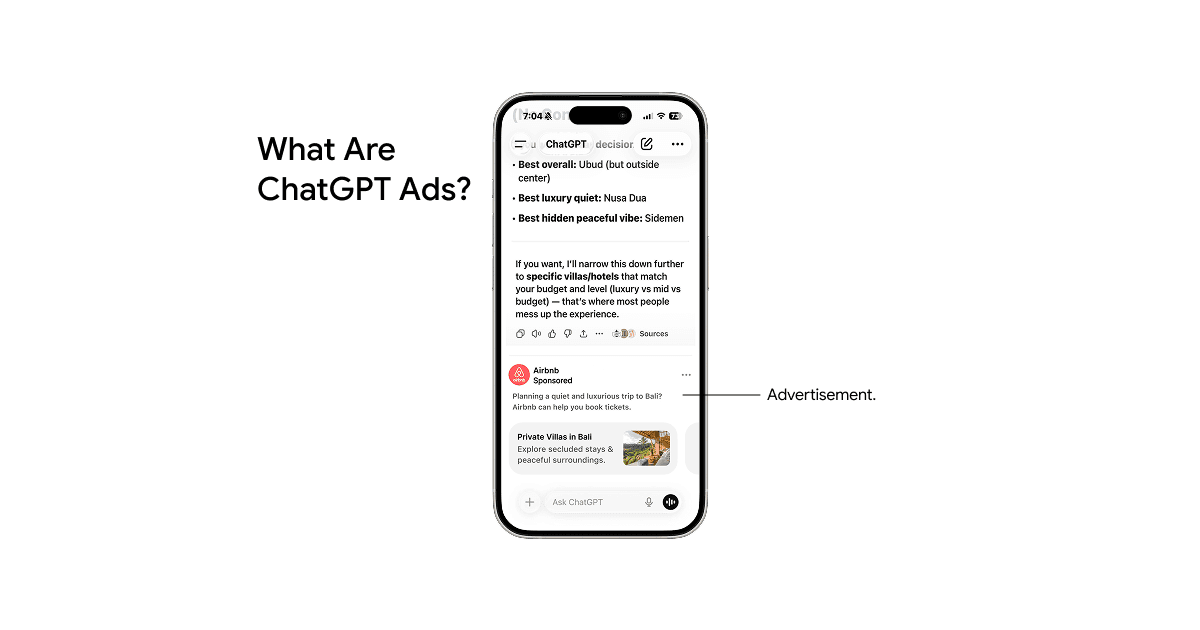
Most People Think ChatGPT Ads Are Just Another Placement
Right now, most teams are approaching ChatGPT Ads with the same mental model they use for Google Ads or social media advertising, and that is where the first mistake happens. They assume this is simply another surface where ads will appear, another inventory source where impressions can be bought, optimized, and scaled. In their minds, it is just an extension of existing channels, where the same playbooks—targeting, creatives, bidding strategies—can be applied with minor adjustments. This assumption is not just slightly incorrect, it is fundamentally wrong, because it ignores the underlying shift in how users interact with information inside conversational AI platforms.
The reason this misunderstanding exists is because every previous evolution in advertising has followed a similar pattern. New platforms emerged, but the core logic remained consistent. Whether it was search, display, or social, the model was still based on visibility and interruption. Ads were layered on top of user behavior, not embedded inside it. So naturally, teams assume ChatGPT Ads will follow the same pattern. But ChatGPT is not a browsing environment. It is a reasoning environment. And that distinction changes everything about how advertising functions inside it.
ChatGPT Is Not a Discovery Platform — It Is a Decision Environment
To understand what ChatGPT Ads actually are, you first need to understand what ChatGPT itself represents. It is not a place where users casually explore content or scroll through options. It is a place where users arrive with intent, ask specific questions, and expect structured answers that help them make decisions. The interaction is not passive. It is active, focused, and outcome-driven. When someone asks ChatGPT which course to choose, which tool to use, or which platform is best for their needs, they are not at the top of the funnel. They are already deep inside the evaluation phase.
This means that ChatGPT is not participating in the discovery phase of the customer journey in the same way as search or social platforms. It is operating closer to the point of decision. The user is not looking for more options; they are looking for clarity between options. The AI is not just presenting information; it is structuring that information in a way that leads the user toward a conclusion. This makes ChatGPT a decision environment, not a discovery platform, and any form of advertising inside it must align with that reality.
What ChatGPT Ads Actually Are
ChatGPT Ads are not banners, not sponsored links, and not interruptive placements. They are context-integrated, intent-aligned responses that exist inside the flow of a conversation where a user is actively making a decision. They are designed to fit inside the reasoning process rather than sit outside of it. Instead of trying to capture attention, they contribute to the answer the user is seeking. This means that the effectiveness of an ad is not determined by how eye-catching it is, but by how relevant it is to the user’s specific query and how well it aligns with the structure of the conversation.
In practical terms, this means that a ChatGPT Ad behaves more like a recommendation than a traditional advertisement. It appears in contexts where the user is evaluating options, and it is positioned in a way that supports that evaluation. It must make sense within the logic of the response. It must answer the question the user is asking. And it must do so in a way that feels natural within the conversation. If it feels forced, irrelevant, or disconnected from the user’s intent, it will fail immediately because the user is not there to be persuaded—they are there to decide.
Why Traditional Advertising Frameworks Fail Here
Most teams will fail with ChatGPT Ads because they will try to apply frameworks that were built for entirely different environments. They will focus on creative variations, visual appeal, and click-through optimization, all of which are secondary in a conversational context. They will attempt to treat ChatGPT like a search engine or a social feed, where the goal is to attract attention and drive traffic. But inside ChatGPT, there is no scrolling feed, no list of competing ads, and no traditional click behavior in the same sense.
The failure happens because these frameworks are optimized for interruption, not integration. In search and social, an ad interrupts the user’s flow and redirects it. In ChatGPT, the ad must become part of the flow. It must align with the user’s reasoning rather than disrupt it. This requires a completely different approach to messaging, structure, and positioning. It is not about saying something louder or more creatively. It is about saying the right thing at the exact moment the user needs it, in a way that directly contributes to their decision.
The Real Unit of Value: Influence Over the Answer
In traditional advertising, the unit of value is attention. Metrics like impressions, clicks, and engagement exist to measure how effectively an ad captures and holds that attention. Inside ChatGPT, the unit of value shifts to influence over the answer. The question is no longer whether the user saw your ad or clicked on it. The question is whether your brand was part of the response that shaped the user’s decision.
This is a much higher bar. It requires alignment with intent, clarity in messaging, and relevance to the specific context of the conversation. It also means that success is less about volume and more about precision. You do not need to reach everyone. You need to be present in the exact moments where decisions are being made. And when you are present, you need to be positioned in a way that makes selection the natural outcome.
Why Most Teams Are Already Misaligned
The majority of teams are not prepared for this shift because their entire advertising infrastructure is built around optimizing attention. Their processes, tools, and mental models are all aligned with channels where visibility drives performance. They measure success based on clicks, conversions, and acquisition costs, all of which assume a multi-step funnel where the user moves from awareness to consideration to decision over time.
Inside ChatGPT, that funnel compresses. The user enters closer to the decision stage, and the time between evaluation and choice is significantly shorter. This makes many existing optimizations irrelevant or insufficient. Teams that do not recognize this will continue to optimize for the wrong variables. They will spend money trying to generate attention in a system where attention is not the bottleneck. The bottleneck is influence.
Early Understanding Is a Competitive Advantage
Because this channel is new, there is currently a gap between how it actually works and how most teams think it works. That gap creates opportunity. The companies that take the time to understand the mechanics of decision-making inside conversational AI will be able to position themselves effectively before the channel becomes saturated. They will learn how to align messaging with intent, how to integrate within conversations, and how to influence outcomes rather than just generate traffic.
Over time, this advantage will compound. As more companies enter the space, competition will increase, and the cost of misalignment will rise. But in the early phase, the barrier is not budget—it is understanding. The teams that get this right early will not just perform better; they will define the standards that others eventually try to follow.
This Is Not an Evolution — It’s a Different System
It is important to understand that ChatGPT Ads are not an incremental improvement on existing advertising models. They represent a different system entirely. The underlying mechanics—how users interact, how decisions are formed, how influence is applied—are different enough that treating this as just another channel will lead to consistent underperformance.
This is not about adding ChatGPT to an existing media mix. It is about recognizing that a new layer has emerged where decisions are increasingly being made, and that operating inside this layer requires a different approach. The sooner this is understood, the faster a company can adapt. And in a system where early alignment leads to compounding advantage, speed of understanding becomes one of the most valuable assets a business can have.
Similar Blogs

Prepare Your Business for Advertising Inside AI Platforms
If your organization is exploring how AI platforms may influence customer acquisition, the AI Ads Readiness Program helps you understand where your brand stands today — and how to prepare for where advertising inside AI systems is going.